What is a vision for a business?
A vision for your business isn’t just a feel-good sentence on a wall. It’s the North Star that shapes strategy, culture, and long-term value.
Let’s break down what a business vision really is, how to write one that doesn’t sound generic, and how to actually use it in planning and execution (not just in a slide deck).
Business Vision Statement Definition
A business vision statement is a short, inspiring description of what you want your business to become in the future.
Think of it as a picture of success 5–10 years from now. It should answer questions like:
- What kind of impact will we have?
- What will we be known for?
- How will our customers, team, and market describe us when we’re “winning”?
A good company business vision statement is:
- Future-oriented – Focused on where you’re going, not where you are now
- Aspirational, but believable – Big enough to inspire, grounded enough to guide decisions
- Short and memorable – Ideally one to two sentences
- Aligned with strategy – It should feed directly into your business planning work and long-term goals
If your team can’t remember your vision without reading it, it’s probably too long or too vague.
What is a vision for a business, really?
When people ask “What is a vision for a business?” they’re usually asking one of two things:
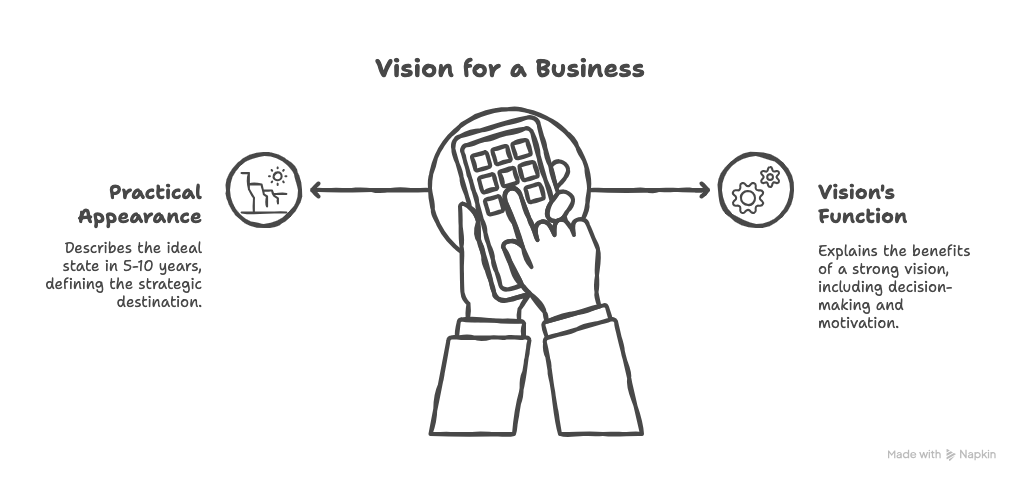
1) What does it look like in practice?
- It’s the answer to: “If everything went right for the next 5–10 years, what would we look like?”
- It defines the destination your strategy is working toward.
2) What job does it actually do?
A strong vision helps you:
- Decide which opportunities to say yes to—and which to say no to
- Align leadership around the same long-term direction
- Motivate employees by giving their work a bigger purpose
- Anchor your strategic planning and KPIs so goals are not random
Put simply: mission explains what you do today; vision explains what you’re trying to become.
Why your business vision matters more than a clever slogan
A clear company vision statement isn’t just “nice branding.” It directly affects performance:
Sharper strategic focus
When your leadership team agrees on the future picture, strategic planning becomes easier. You’re not just chasing projects—you’re building toward a defined future state.
(If you’re working on formal planning, it’s worth revisiting the benefits of strategic planning and how a strong vision underpins them.)
Better decision-making
A good vision acts like a filter:
“Does this move us closer to that future?”
If not, it’s easier to deprioritize.
Stronger culture and engagement
Employees don’t get excited about “hitting 12% EBITDA.” They get excited about:
- Improving lives
- Changing an industry
- Building something meaningful
Consistency over time
Markets, tools, and tactics change. A well-defined vision gives you continuity so you can evolve how you operate without losing why you’re doing it.
Business vision statement vs mission statement
People often mix these up, so here’s the simple distinction:
| Concept |
Focus |
Timeframe |
Example question answered |
| Vision |
Future destination |
5–10+ years ahead |
“What are we ultimately trying to become?” |
| Mission |
Current purpose |
Today & near term |
“What do we do, for whom, and how do we do it?” |
A quick example:
- Vision:
- “To become the most trusted advisor platform for mid-market business owners worldwide.”
- Mission:
- “We help privately owned businesses grow, de-risk, and plan their exit with data-driven tools and expert advice.”
Your strategic plan sits between these two: it’s the bridge that connects today’s mission to tomorrow’s vision.
How to write a business vision statement (step-by-step)
You don’t need a two-day offsite to get started. Use this simple process with your leadership team:
1. Start with three questions
Ask (and write down answers to):
- If we were wildly successful in 10 years, what would that look like?
- What would customers say about us?
- What kind of impact would we be proud of?
Don’t worry about perfect wording yet—just capture ideas.
2. Pull out the key themes
Look for repeated ideas such as:
- Being the most trusted or most recommended
- Leading in innovation, service, or impact
- Serving a specific group (e.g., family businesses, advisors, manufacturers)
- Changing how something is done in your industry
These themes will shape the core of your business vision statement.
3. Draft 2–3 versions
Turn those themes into one or two sentences. Example formats:
- “To [do something big] for [who], by [how you’re different].”
- “To become the leading [type of company] that [impact you create].”
Don’t worry about perfection—aim for clear, simple, and specific.
4. Test it with your team
Ask a few questions internally:
- Can people repeat it without reading?
- Does it feel too generic (could it describe any company)?
- Does it actually guide decisions? (Would it change what we focus on?)
If it feels like it could belong to any bank, hospital, or SaaS company, it’s not specific enough.
5. Align it with your strategic plan
Once your vision is set, tie it directly into planning:
- Turn the future picture into 3–5 long-term objectives
- Tie those to annual goals and KPIs in your business planning tools
- Revisit it when you review strategy each year
%20-%20visual%20selection.png?width=923&height=528&name=How%20to%20write%20a%20business%20vision%20statement%20(step-by-step)%20-%20visual%20selection.png)
Examples of strong business vision statements
Here are a few simple, effective patterns you can adapt:
Impact-focused vision
“To empower every mid-market business owner to understand, grow, and realize the full value of their company.”
Customer-experience vision
“To be the most trusted partner for advisors who help business owners plan, grow, and exit on their terms.”
Market-position vision
“To become the standard global platform advisors use for strategic planning, succession, and exit readiness.”
Note: the best business vision statements sound like you. Avoid jargon and buzzwords, lean into clear, human language.
Putting your business vision to work
A great vision statement only matters if you use it. Here’s how to embed it into daily operations:
- Strategy: Use it as the first page of your strategic plan and as the reference point for major decisions.
- Planning & KPIs: Make sure annual goals and KPIs clearly support the vision. (If they don’t, refine them.)
- Communication: Include the vision in onboarding, leadership meetings, and major internal updates.
- Reviews: Revisit the vision when you review performance and update your plans—you’re asking, “Are we moving toward this?”
Over time, your vision becomes less “wall art” and more of an operating filter for a successful business.
FAQ: What Is a Vision for a Business?
How can I create a compelling business vision?
Start by imagining your business 5–10 years in the future at its best: who you serve, what you’re known for, and the impact you’ve made. Write down that picture in plain language, then refine it into one or two sentences that your team members can remember and repeat.
Finally, make sure your vision connects directly to your strategy and planning—link it to concrete goals, KPIs, and your overall strategic planning process.
Which business vision software tools help with strategic planning?
The best tools don’t just store a vision statement—they help you execute on it.
Platforms like Maus allow you to:
- Capture your business vision and long-term objectives
- Turn them into structured business planning roadmaps
- Track KPIs and progress against your vision over time
Instead of treating your vision as a static slide, Maus helps you connect it to real-world actions, dashboards, and reviews so it actively guides your strategic decisions.
How do successful companies communicate their business vision to customers?
Successful companies live their vision instead of just posting it on a page. Common practices include:
- Using the vision to shape brand messaging and marketing stories
- Making sure customer promises clearly reflect the future they’re building
- Training frontline teams to explain why the company exists, not just what it sells
- Sharing progress toward the vision in newsletters, annual reports, and key updates
When customers repeatedly see your vision reflected in your decisions, products, and service experience, it stops being just a statement and becomes part of how they recognize and trust your brand.

 Attract
 Engage
 Build
Build