Affordable software solution for independent financial advisors
Independent financial advisors are under pressure to do more with less, more planning, more reporting, more client communication, without adding runaway software costs.
The right affordable software solution for independent financial advisors isn’t just “the cheapest tool”; it’s the stack that gives you planning depth, practice efficiency, and room to scale without breaking your budget.
This guide breaks down what “affordable” should really mean, how to evaluate tools, and where an all-in-one platform like Maus can replace spreadsheets and disconnected point solutions.
1-minute recap: what “affordable” advisor software really looks like
If you only take one thing away from this article, make it this:
- Affordable = total cost of ownership, not just the monthly fee. Consider licenses, implementation, staff time, integrations, and opportunity cost.
- Start with a core stack: financial planning & analysis, CRM/client engagement, secure document workflow, and billing. Spreadsheets (Excel/Sheets) are a useful bridge, but they don’t scale for regulated, client-facing work.
- Integrated platforms are often cheaper long-term. Patchworking a planning tool, analytics tool, exit-planning spreadsheets, and reporting app can cost more than a single platform that unifies strategic planning, financial analysis, and exit/succession modeling.
- Maus is designed exactly for this gap. It gives independent advisors strategic planning, business/exit planning, and financial analysis tools in one place, with simple, transparent pricing for firms of all sizes.
We’ll unpack how to evaluate your options, and where Maus fits, in the sections below.
Why affordable software matters more than ever for independent advisors
The advisor tech landscape has exploded: planning software, CRM, TAMPs, billing, client portals, risk tools, risk tolerance, analytics, AI assistants… and almost all of them are subscription-based.
One recent practice-management article found that “over half of financial advisors are considering leaving their current firm for one with better tech tools”, underscoring how central software has become to both advisor satisfaction and client experience.
For independent advisors, that presents a double challenge:
- You don’t have an enterprise CTO vetting tools for you.
- You can’t afford a bloated tech stack with overlapping functionality.
That’s why “affordable” software should be judged on three dimensions:
- Revenue impact – Does this tool help you win or retain clients (e.g., by offering exit planning, better planning visuals, or a more professional experience)?
- Efficiency gains – Does it reduce manual work (spreadsheets, re-keying client data, formatting reports, copying numbers into pitch decks)?
- Scalability – Will it still work when you 3–5x your client base, or will you have to rip and replace?
What independent advisors actually need from software (not just vendor logos)
Google’s AI Overview highlights common categories, planning tools like RightCapital, CRMs like Wealthbox, Excel/Google Sheets for custom work, accounting tools like QuickBooks, and all-in-one platforms like Orion or eMoney.
That’s directionally correct, but independent advisors don’t need every category on day one.
%20-%20visual%20selection.png?width=972&height=636&name=What%20independent%20advisors%20actually%20need%20from%20software%20(not%20just%20vendor%20logos)%20-%20visual%20selection.png)
Think in functions, not brands:
1. Financial planning and analysis
You need to:
- Build cash-flow and retirement projections
- Run what-if scenarios
- Stress-test portfolios and business cash flows
Good financial analysis software consolidates data from accounting systems, spreadsheets, and other sources into clear, actionable reports, so every recommendation is backed by accurate insights.
Maus supports this through built-in financial analysis, scenario modeling, and business valuation tools designed for advisors and consultants.
2. CRM and client engagement
A lightweight CRM (or good CRM discipline) helps you:
- Track meetings, tasks, and follow-ups
- Keep a history of plans, assumptions, and decisions
- Segment clients by life stage, complexity, or business-owner vs. non-owner
Whether you use a purpose-built advisor CRM or a general CRM, connect it to your planning & analysis tools so you’re not re-entering data.
3. Document storage & workflow
You need secure, compliant storage for:
- Client onboarding documents
- Engagement letters
- Exit-planning reports and strategic plans
Cloud storage or document-management tools are fine, but tying them into a platform that auto-generates reports and presentations is far more efficient.
4. Billing & revenue tracking
Even if you rely on QuickBooks or a similar tool today, you’ll eventually want:
- Recurring billing for retainers and planning fees
- Clear profitability views by client or segment
- Easy export for tax and compliance reporting
5. Exit and succession planning (the overlooked profit center)
This is the category AI Overviews often miss—but it’s where independent advisors can differentiate the most.
Exit planning is regarded as “the next major value horizon for financial advisors, much like estate planning was previously”.
If you work with business-owner clients, exit and succession planning is where you can:
- Deepen client relationships
- Expand share of wallet
- Win new mandates that legacy advisors ignore
This is exactly where Maus is positioned. Learn more about Maus.
Why an integrated exit-planning platform can be the most affordable solution
Instead of bolting together separate tools for:
- Strategic planning
- Business valuation
- Financial analysis
- Exit & succession modeling
- Reporting and presentation
…Maus provides an all-in-one platform that covers these workflows in a single subscription.
For independent financial advisors, that delivers affordability in three ways:
Unlimited clients, predictable pricing
Maus’s pricing is built around unlimited clients and how you use the software (Attract, Engage, or Build), not per-client fees that punish growth.
Fewer tools to buy and integrate
Instead of maintaining separate licenses for planning, valuation spreadsheets, exit-planning templates, and reporting, you consolidate those functions into Maus.
Time savings you can measure
Advisors using Maus report meaningful efficiency gains. In one case study, Virginia Asset Management grew revenue by 400% after integrating Maus into its exit-planning offering—showing how the right platform can unlock both time savings and new fee revenue.
How Maus fits into an affordable advisor tech stack
Here’s how Maus lines up against the core needs we outlined earlier:
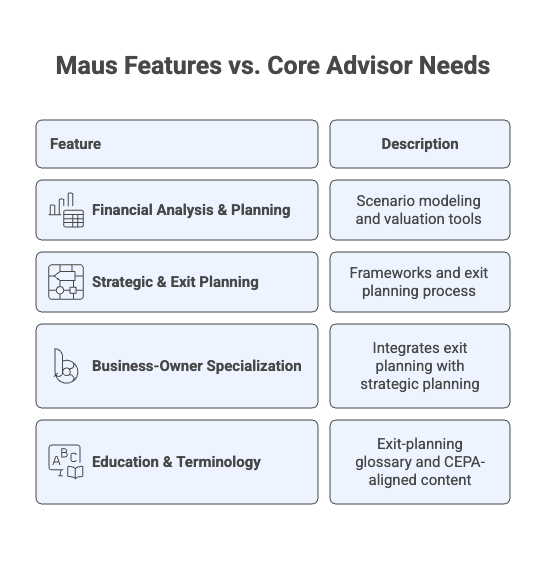
- Financial analysis & planning – Maus provides scenario modeling, KPIs, and valuation tools that support deeper advisory conversations, not just portfolio performance.
- Strategic and exit planning – Frameworks, templates, and a seven-stage exit planning process tailored for advisors help you guide owners from “curious” to “transaction-ready.”
- Business-owner specialization – Maus integrates exit planning with strategic planning and value-driver analysis, making it easier to apply concepts you’ll find in resources like “Exit Strategies for Entrepreneurs: How to Align Your Strategic Plan with Long-Term Goals.”
- Education and terminology – An exit-planning glossary and CEPA-aligned content help you and your team speak the language of value acceleration and transition.
Because Maus sits beside your custodian, CRM, and accounting system, it becomes the bridge between personal wealth planning and business-owner value planning.
Internal Maus resources that deepen your tech ROI
If you want to go beyond “which software should I buy?” and into how to use it strategically, there are several Maus articles worth weaving into your learning path:
Linking these resources from your own content or client education materials reinforces your positioning as a tech-enabled, process-driven advisor.
Step-by-step checklist: choosing an affordable software solution
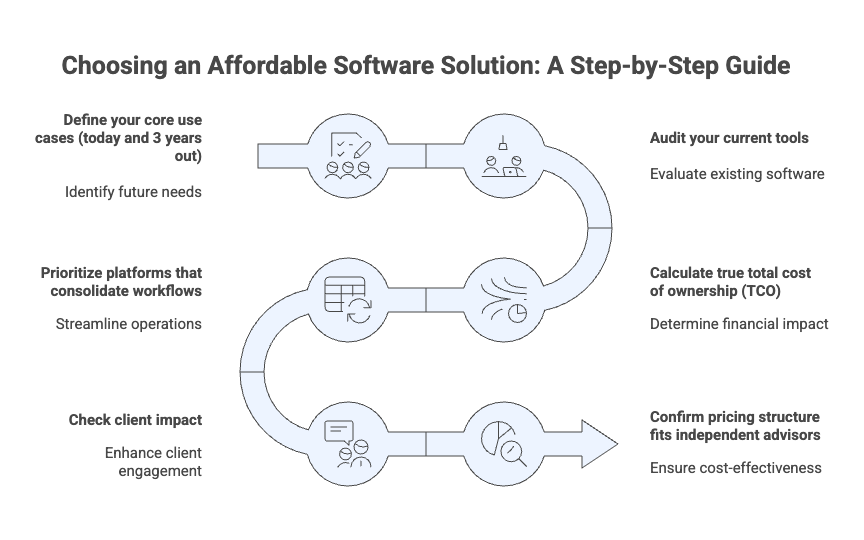
Use this checklist before you sign any new software contract:
Define your core use cases (today and 3 years out)
Serving mass-affluent households only? Or also business owners?
Do you want to add exit/succession planning, value-driver analysis, or CEPA-style engagements?
Audit your current tools
Where are you already paying twice for similar features (planning, analytics, reporting)?
Which workflows still live in Excel/Sheets because existing tools can’t handle them?
Calculate true total cost of ownership (TCO)
License fees (per-user, per-account, or per-AUM)
Implementation and data-migration time
Staff hours on report building, templates, and manual processes
Prioritize platforms that consolidate workflows
Can the tool handle strategic planning, business analysis, exit planning, and reporting together (like Maus)?
Does it integrate with accounting tools like QuickBooks or Xero so you aren’t re-keying data?
Check client impact
Will this software help you explain complex topics—like exit readiness, value drivers, or retirement projections—in a visual, client-friendly way?
Can you easily generate deliverables that justify your fees?
Confirm pricing structure fits independent advisors
Avoid models that penalize growth with steep per-client fees.
Look for unlimited-client pricing or tiers that scale predictably (as Maus does for financial advisors).
If you can check these boxes, you’re looking at a genuinely affordable solution—not just a low sticker price.
One external perspective: why tech investment is non-negotiable
Affordability shouldn’t be confused with under-investing in technology.
A 2025 article on must-have financial advisor tools notes that embracing the right tools is now the difference between “honing your competitive edge and falling behind”, and highlights that more than half of advisors would switch firms for better tech.
For independent advisors, that same logic applies at the practice level: if your software is slow, fragmented, or visually underwhelming, clients will notice—and so will your staff.
The key is to invest in the fewest, most powerful platforms that support your strategy. For a wide range of advisors serving business owners, that means adding Maus as the strategic planning and exit-planning hub of your stack.
FAQs: affordable advisor software & Maus
1. What is the most affordable software solution for an independent financial advisor just starting out?
If you’re brand-new and cash-constrained, it’s reasonable to combine spreadsheets with a basic CRM and low-cost billing tool. But as soon as you start serving business-owner clients or offering deeper planning, you’ll outgrow that setup. At that point, a platform like Maus for Financial Advisors, which consolidates financial analysis, strategic planning, and exit planning in one place with unlimited clients, often becomes more affordable than juggling multiple point solutions.
2. How does Maus compare to traditional financial planning software on cost?
Traditional planning tools often price around per-advisor or per-client licenses and may focus primarily on household retirement planning. Maus is designed for advisors who want to add business advisory and exit planning, with transparent pricing tiers and unlimited clients so you can scale revenue without steep incremental software costs.
3. Can Maus replace spreadsheets for business valuation and exit planning?
Yes. Maus includes built-in financial analysis, business valuation, and exit-planning frameworks so you can move beyond ad-hoc spreadsheets into a consistent, auditable process. This reduces errors, speeds up modeling, and produces more professional client deliverables.
4. Is Maus only useful for large advisory firms?
No. Maus was intentionally designed so firms and practices of all sizes—including solo and small independent advisors—can deliver institutional-grade exit planning and strategic advisory work. Pricing is structured to support smaller practices and grow with you as you add clients and service lines.
5. How does Maus help me differentiate my practice while staying affordable?
By adding exit and succession planning, value-driver analysis, and strategic planning services, you move from portfolio manager to primary advisor on the client’s biggest asset: their business. Maus gives you the tools, templates, and education (including CEPA-aligned resources and an exit-planning glossary) to deliver that value efficiently—so the same hours you spend with clients generate higher fees and stickier relationships.

 Attract
 Engage
 Build
Build