Top 10 Business Exit Strategies (and How to Choose the Right One)
For most owners, an exit strategy isn’t just about the day they leave — it’s about how every major decision is made long before that day arrives.
A well-designed business exit strategy connects your business plan, your succession plan, and your personal and business goals into a single roadmap. It helps you understand your exit options, prepare your management team, adapt to market conditions, and ultimately sell the business on your terms.
This guide walks through the most common exit strategies, when each type of exit strategy makes sense, and how owners can prepare for a smooth transition while protecting value and maximizing profits.
What Is a Business Exit Strategy?
A business exit strategy is a plan for how an owner will reduce or end involvement in a company while converting business value into personal financial outcomes. Exit strategies include selling the business, transferring ownership, recapitalizing, or winding operations down in an orderly way.
Importantly, an exit strategy should not live in isolation. It should be integrated into your business plan, aligned with a succession plan, and revisited as the company grows or market conditions change.
For foundational context, see What Is an Exit Strategy in Business?
Common Exit Strategies at a Glance
Before diving into detail, here’s a high-level view of the types of exit strategies owners typically evaluate:
| Exit Strategy Type |
Best For |
Key Tradeoffs |
| Sale to a third party |
Owners seeking liquidity and valuation upside |
Buyer control, deal complexity |
| Management buyout |
Continuity-focused owners |
Financing constraints |
| Family succession |
Legacy-driven businesses |
Governance & fairness challenges |
| Initial public offering (IPO) |
High-growth companies |
Regulatory burden, market timing |
| Partial sale / recap |
Owners wanting liquidity + control |
Shared governance |
| Employee buyout / ESOP |
Culture-driven firms |
Complexity, staged payouts |
| Strategic buyer sale |
Niche or differentiated businesses |
Integration risk |
| Acqui-hire |
Talent-heavy companies |
Lower valuations |
| Orderly liquidation |
Declining businesses |
Minimize losses, lower returns |
| Wind-down |
Lifestyle businesses |
Limited transferable value |
Each option has very different implications for risk, value, and control.
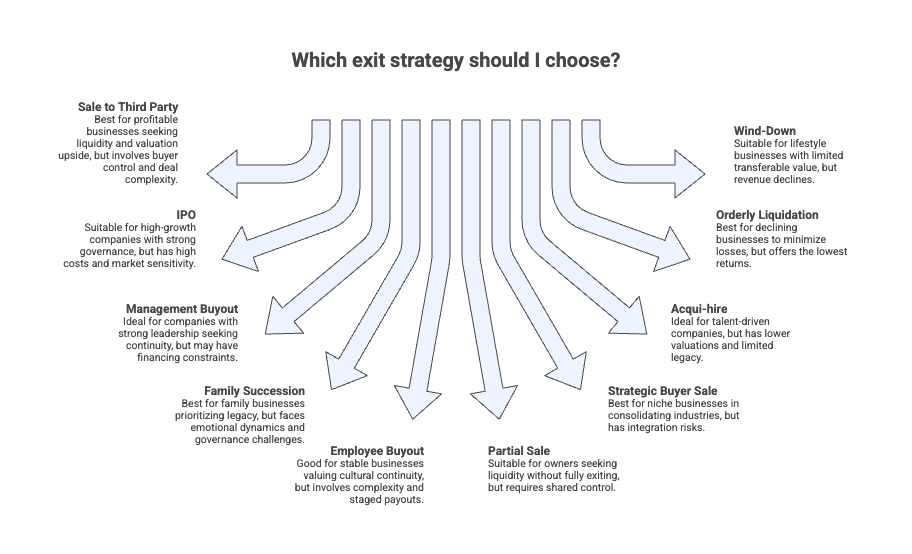
1. Sale to a Third Party (M&A)
Selling the business to a third party, such as a strategic buyer or private equity firm, is one of the most common exit strategies.
Best for:
Key considerations:
-
Buyers focus on enterprise value, not owner effort
-
Owner dependence and customer concentration reduce value
-
Deal structures often include earn-outs and transition periods
This exit strategy can maximize profits, but only if the business is transferable and well-prepared.
2. Initial Public Offering (IPO)
An initial public offering (IPO) allows owners and investors to sell shares on public markets.
Best for:
Key considerations:
-
Significant regulatory and compliance costs
-
Liquidity is often staged over time
-
Highly sensitive to market conditions
IPOs are powerful but rare and unsuitable for most privately held businesses.
3. Management Buyout (MBO)
In a management buyout, the existing management team purchases the business.
Best for:
Key considerations:
MBOs work best when leadership already operates independently of the owner.
4. Family Succession
Family succession transfers ownership to the next generation.
Best for:
Key considerations:
Without planning, family succession can increase risk rather than reduce it.
5. Employee Buyout or ESOP
Employees acquire ownership directly or through an ESOP.
Best for:
Key considerations:
Often produces staged liquidity rather than a single payout
6. Partial Sale or Recapitalization
Owners sell a portion of the business while retaining equity.
Best for:
Key considerations:
7. Strategic Buyer Sale
A strategic buyer values synergies such as technology, customers, or market access.
Best for:
Key considerations:
Strategic buyers may pay premiums, but only when synergies are clear.
8. Acqui-hire
The buyer acquires the team rather than the business itself.
Best for:
Key considerations:
-
Lower valuations
-
Limited long-term legacy
9. Orderly Liquidation
Assets are sold to pay obligations and minimize losses.
Best for:
Key considerations:
10. Wind-Down Without Sale
The owner gradually exits without a formal transaction.
Best for:
Key considerations:
Exit Strategy vs. Exit Readiness
An exit strategy defines how you plan to exit.
Exit readiness determines whether you actually can.
Exit-ready businesses:
Operate without owner dependence
Have clean financials and documented processes
Support a smooth transition across exit options
This distinction is explored in 15 Exit-Readiness Checks Every Owner Should Pass.
Understanding how value converts at exit also matters. See Enterprise Value vs. Equity Value.
How Exit Strategy Fits Into a Business Plan
A strong exit strategy should be embedded into your business plan, not added at the end. It helps owners:
Align personal and business goals
Prepare the management team for independence
Adapt to changing market conditions
Preserve optionality as the business evolves
Owners who plan early don’t just exit better — they build better businesses.
For broader context, see Exit Strategies for Entrepreneurs.

 Attract
 Engage
 Build
Build